Your 'Eco-Friendly' Label Just Became a Compliance Document
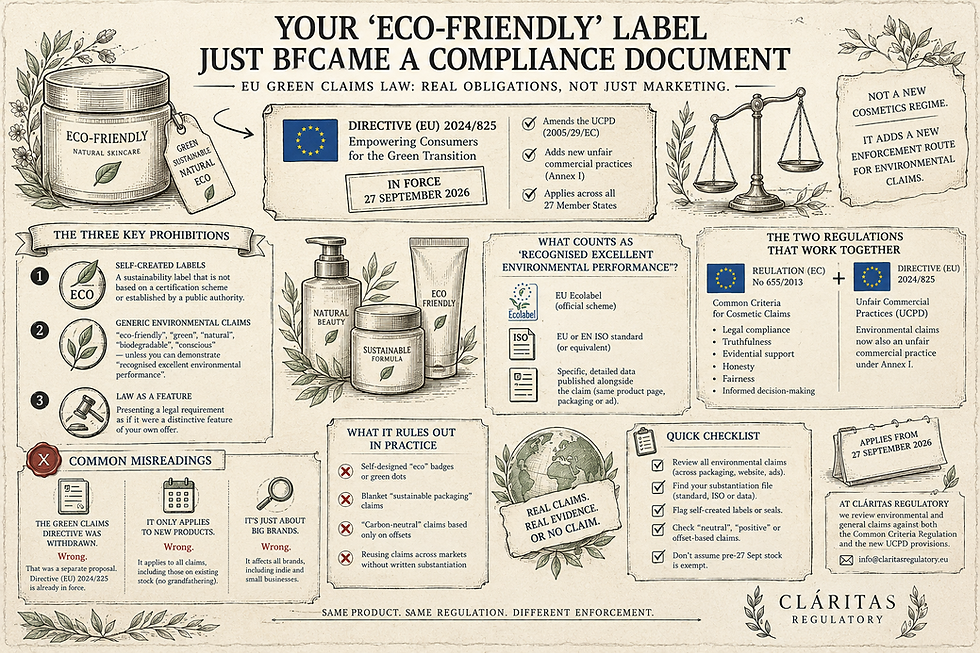
Directive (EU) 2024/825 started applying across the EU on 27 September 2026 — and it changes what "green", "sustainable" and "clean beauty" are allowed to mean on a cosmetic label.
Most indie beauty brands who tracked the EU's "Green Claims Directive" filed the whole environmental-claims question under "stalled" or "withdrawn." That's not wrong — the European Commission did signal, in June 2025, that it intended to withdraw that specific proposal after Parliament and Council talks broke down over which businesses it would cover. What most brands missed is that a different, already-adopted piece of EU law quietly reached its own compliance date this week. Directive (EU) 2024/825 — the Directive on Empowering Consumers for the Green Transition, usually shortened to "EmpCo" — started applying across all 27 Member States on 27 September 2026. It doesn't create a new cosmetics-specific regime. It amends the Unfair Commercial Practices Directive (2005/29/EC), and from this week, an "eco-friendly" or "sustainable" claim that used to be a marketing choice is, legally, a claim you now have to be able to defend on demand.
The mechanism most brands are missing
Directive (EU) 2024/825 adds new entries to Annex I of the UCPD — the EU's list of commercial practices considered unfair "in all circumstances," with no case-by-case balancing test required. Three of them matter directly to cosmetics marketing:
Displaying a sustainability label that is not based on a certification scheme or established by a public authority.
Making a generic environmental claim — "eco-friendly," "green," "natural," "biodegradable," "conscious" — for which the trader cannot demonstrate "recognised excellent environmental performance" relevant to the claim.
Presenting a requirement imposed by law as if it were a distinctive feature of the trader's own offer.
The second one is the one that touches almost every cosmetics label in the EU. "Recognised excellent environmental performance" is not a marketing judgment call — it has to be demonstrated through compliance with an EU-recognised standard (an EU Ecolabel, an EN ISO standard, or equivalent), or through detailed, specific substantiation published on the same medium as the claim itself: the same product page, the same packaging panel, the same ad.
Why "the Green Claims Directive was withdrawn" is the wrong takeaway
This is the mistake we're seeing most often right now, and it's an understandable one, because the two files share a name in casual conversation. The draft Green Claims Directive was a separate proposal that would have required third-party verification of environmental claims before they were made; the Commission signalled its withdrawal in June 2025 after trilogue talks stalled over SME scope, and its status remains formally unresolved. Directive (EU) 2024/825 is a different, already-in-force instrument — adopted in February 2024, with Member States required to transpose it into national law by 27 March 2026, applying from 27 September 2026. Brands that concluded "green claims regulation isn't happening" acted on the wrong half of the story. The verification-before-claim regime didn't arrive. The ban on making the claim without being able to back it up already has.
What "recognised excellent environmental performance" rules out
For an indie cosmetics brand, in practice this rules out a specific and common set of habits:
A self-designed leaf, green dot, or "eco" badge printed on packaging with no certification body behind it.
A blanket "eco-friendly formula" or "sustainable packaging" claim covering the whole product when only one ingredient, or one component such as a refillable jar, is actually the basis for it.
A "carbon-neutral" claim resting only on offsets purchased elsewhere in the value chain, rather than on demonstrated emissions reductions.
Reusing a claim across markets without checking whether the substantiation was ever written down anywhere accessible to a regulator or a competitor.
None of these require intent to deceive. Annex I practices are unfair regardless of the trader's good faith — which is exactly why enforcement doesn't need to prove you meant to mislead anyone, only that the claim, as displayed, doesn't meet the bar.
How this sits alongside your existing claims obligations
This doesn't replace the framework cosmetics brands already work under. Commission Regulation (EU) No 655/2013 has, since 2013, required every claim on a cosmetic product — environmental or otherwise — to meet six common criteria: legal compliance, truthfulness, evidential support, honesty, fairness, and informed decision-making. Directive (EU) 2024/825 doesn't lower or replace that bar for environmental claims; it adds a second, EU-wide enforcement route through national consumer-protection authorities, on top of the cosmetics-specific one. A claim that would already have failed the Common Criteria Regulation was already non-compliant. What's new is that it's now also, independently, an unfair commercial practice — which means it can be pursued through consumer law even where a cosmetics regulator has never looked at it.
What to check this week
Pull every environmental or sustainability-adjacent claim across your packaging, product pages, and ads — including implied ones carried by colour, imagery, or a product or brand name.
For each one, locate or write the substantiation file: which standard, ISO reference, or specific data supports it, and where it is displayed.
Flag any self-created label, badge, or seal that isn't tied to a recognised certification scheme or public authority.
Check "neutral," "positive," or offset-based claims specifically — these are named in the Directive's recitals as needing hard substantiation, not just intent.
Don't assume packaging printed before 27 September is exempt: there is no stock grandfathering built into the Directive.
At Cláritas Regulatory we review environmental and general claims together, against both the Common Criteria Regulation and the new UCPD provisions, before they go on packaging — not after a competitor or a consumer authority flags them. If you want a claim-by-claim check before your next print run, get in touch.


Comments